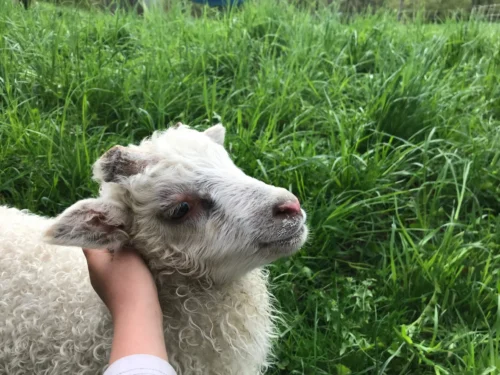
Grass-fed Lamb
Icelandic lamb is known for being some of the most mild-flavored and tender lamb in the world and is prized by chefs for its gourmet flavor and fine-grained texture. It is naturally leaner than most modern breeds of sheep (or beef) and has the added nutritional and ecological benefits intrinsic to grass-fed, pastured animals and grazing systems.
Our lambs are raised on a combination of rich mother’s milk and lush, diverse pasture—that’s all. We allow our lambs to mature naturally and do not force wean or give them any feed concentrates, antibiotics, or growth hormones. Additionally, we do not dock tails, dehorn, or castrate any of our animals. They roam our hillside fields and forage at will on a wide variety of wild herbs, plants and berries in addition to the typical pasture grasses and legumes.
While the genetic legacy of these sheep predisposes their meat to have such desirable taste and high quality, the flavor of our lamb is specific and unique to this region and this land, and it is incredible.
Lamb Shares
We are now taking reservations for 2026 lamb shares
Our on-farm harvest takes place in late autumn and shares are ready to pick up in late December/early January. In order to comply with local law, any animal harvested on-farm in Massachusetts must be sold prior to harvest day. Please contact us to reserve your share with a $100 deposit.
- We offer lamb for sale as wholes/halves at $16/lb.
- Whole lambs range in size from 25-37 lbs of packaged meat, the majority of which will be bone-in cuts, along with 1-2 pounds of boneless stew meat.
- Half lambs are comprised of 12-18 lbs of cuts.
- We have a limited amount of organ meat available as well for $7/lb.
- Whole shares can add a sheepskin to their share at 10% discount.
Concerned about storage? A whole lamb packs down to a very efficient 1.3-1.5 cubic feet.
Harvest Day
As shepherds, we pride ourselves not only on giving our animals a good life, but also on giving them a good death.
Throughout our several years of apprenticing on farms that raise livestock for meat, we took part in harvest day on multiple occasions and were deeply affected by the striking difference in experience– both in ourselves and that which we saw in the animals– when harvest took place on the farm as opposed to loading and transporting the animals off-site for slaughter.
On-farm harvest always proved a much less chaotic and less stressful experience for the animal: There is no being loaded onto a trailer for the first time in their life; there is no driving several hours in the dark and unloading into an unfamiliar place with strange new smells where they must sometimes wait for hours.
There is waking up in the same barn where they were born with the same faces and smells. There is ceremony and tears and prayer to honor their life. There is deep presence, reverence, and grief in their death. There are brief moments of fear and discomfort for the animal as opposed to many hours of it.