About Us
Our Story
Hi, we’re Sarah and David, first-generation shepherds at Toggenthel Farm. We turned to organic farming as young adults because it seemed like a practical and immediate way to help heal the planet and tackle the root cause of some of the health issues afflicting humans in the modern world. After a combined fifteen years working on organic and regenerative farms, we came to believe that in order to create true and lasting change in our farming and food systems—and therefore in the health of our planet and fellow humans—we must not only radically change the way we grow our food; we must also radically change our relationship to our food.
For only when we remember that our daily bread isn’t mere calories or macros but rather a sacred, life-giving gift from the earth may we enter the state of deep gratitude from which we can’t help but feel compelled to waste less, protect what we have, and give back more in exchange for this precious gift of sustenance. Gratitude also enables us to be more deeply nourished and healed by the food we eat—beyond just the physical—through instilling a deeper sense of connection, purpose, and belonging to the world around us.
As indigenous scholar and author Robin Wall Kimmerer writes:
The next step in our cultural evolution, if we are to persist as a species on this beautiful planet, is to expand our protocols for gratitude to the living Earth. Gratitude is most powerful as a response to the Earth because it provides an opening for reciprocity, to the act of giving back…Let us live in a way that the earth will be grateful for us.
This is really what our farm is about more than anything else: trying to farm in a way so that the earth—and our flock, and our children, and future generations—will be grateful for us. This not only means farming in a way that is focused on humane husbandry and regenerative practices but that also provides opportunities for all of us to step into deeper connection, gratitude, and reciprocity with our food and the land that provides it.
Raising food and eating food are sacred acts and we want to help reclaim that.
We wouldn’t be here today doing what we’re doing if it weren’t for the guidance and mentorship of the farmers, shepherds, and visionary thinkers who showed us the way and who continue to be a source of inspiration and support for us every single day.
Adam Silverstein, Ewell Culbertson, Julie Rawson and Jack Kittredge, David Fisher, Kathy Taft Boyden, Brittany Terry, Robin Wall Kimmerer, Dr. Vandana Shiva, Mary Oliver, Wendell Berry, Michael Pollan, and so many others: Thank you for the work you do in this world. We are eternally grateful for your courage and leadership
Why Icelandic Sheep?
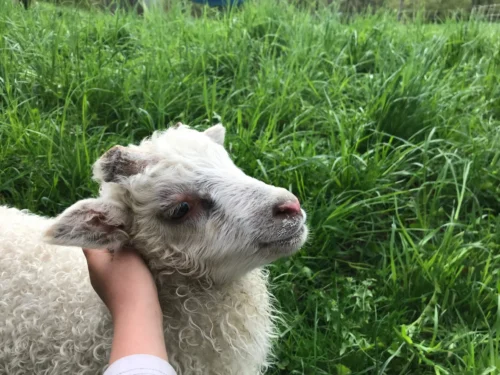
Icelandic sheep are considered a triple-purpose breed as they provide excellent meat, milk, and fiber. They are known and valued by their shepherds for having robust immune systems with a naturally high resistance to disease and parasites and for being excellent mothers that lamb easily, are highly prolific (175-220% average) and are capable of raising multiples without assistance.
Historically, the growing season in Iceland was too short to produce and dry grain for storage so the breed has been selected for over 1100 years to thrive on pasture and hay without the addition of grain or other feed concentrates. This results in naturally leaner and more mildly-flavored meat and is why Icelandic lamb is known as some of the mildest, most tender, and fine-grained lamb in the world.
Icelandics have naturally short tails and mate seasonally so there is no need to dock those adorable lamb tails or castrate males as is commonly practiced throughout the livestock industry.
Icelandic sheep are renowned for having some of the warmest and most luxurious fleeces in the world. Their wool grows at a rate of 10-18” per year(!), is dual-coated, and comes in the widest range of colors and patterns (17, to be exact!) of any sheep, making for iconic sheepskins and fiber arts projects galore.